

How to analyze a screenplay: a practical framework
Analyze a screenplay in seven focused passes for premise, structure, character, scenes, dialogue, craft, and production implications.
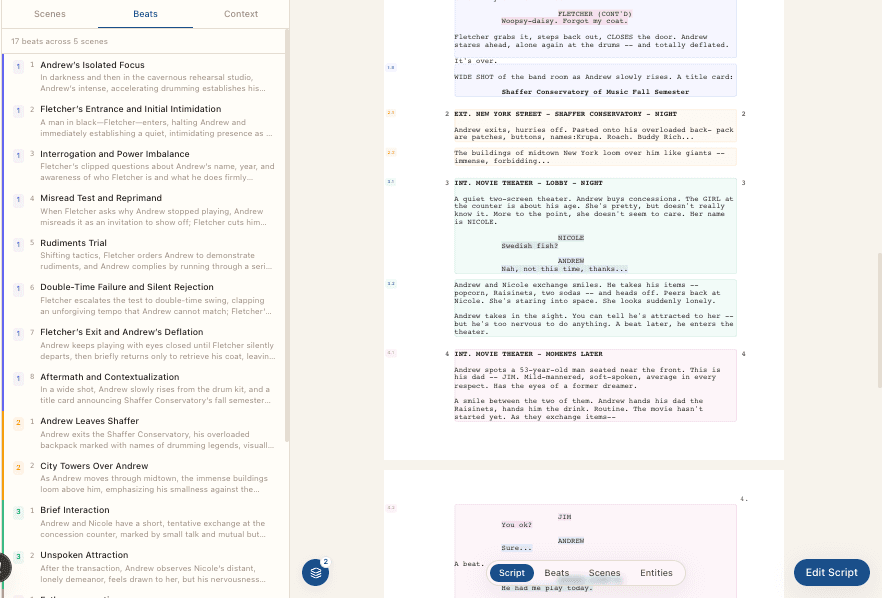
Screenplay analysis explains how a script creates its effect and where it stops doing the intended job. A useful analysis is not a plot recap, a list of preferences, or a score without evidence. It connects claims to scenes, choices, relationships, and changes across the whole draft.
Use separate passes so one strong element does not hide another weak one. Read the screenplay once without stopping, then work through the seven passes below.
Before the first pass
Record the title, format, draft date, page count, and the exact version being reviewed. Ask who the analysis is for and what decision it should support. A writer seeking revision priorities needs different emphasis from a producer deciding whether to pursue a project.
Write the intended audience and genre in pencil, not ink. The screenplay may reveal a different contract than the title page or pitch suggests.
Pass 1: premise and dramatic question
Reduce the story to a protagonist, an urgent want, a source of opposition, and meaningful stakes. Then state the central dramatic question.
For a fictional harbor thriller, that question might be: Can Mara expose a falsified cargo system before her investigation implicates the partner she trusts? The question identifies both the external goal and the relationship cost. If the screenplay keeps asking a different question, the premise and execution may be misaligned.
Check:
- What makes this situation specific?
- Why must this protagonist act now?
- What becomes worse if they fail or delay?
- Does the ending answer the question raised by the opening?
Pass 2: structure and escalation
Map the major turns without forcing the script into a branded beat system. Note the disruption, commitment, reversals, crisis choice, final action, and resulting condition.
The test is cause and consequence. If two sequences could switch places without changing the story, escalation may be weak. If the midpoint only adds spectacle but does not change knowledge, strategy, power, or cost, it may not be a true reversal.
Pass 3: character agency and relationships
Track the choices that cause the plot to move. A protagonist can occupy many pages while another character makes every consequential decision.
For each major character, record:
- Immediate and long-term goals.
- Tactics used to pursue them.
- A contradiction visible in behavior.
- The choice that carries the greatest cost.
- What changes in their belief, strategy, or commitment.
Treat relationships as movement. In the harbor example, Deck may begin as Mara's trusted source, gain leverage when he hides the ledger, then lose her trust when she chooses to expose it. That progression is more useful than labeling him "ally turned antagonist."
Pass 4: scene function and sequence design
Every scene does not need a twist, but it should change something. For each scene, identify who wants what, what blocks them, what turns, and what new pressure follows.
Flag scenes that repeat information, begin before the conflict, end after the turn, or explain an emotion already clear in behavior. Then inspect sequences. Several individually competent scenes can still create a flat sequence if they repeat the same kind of pressure.
Pass 5: dialogue and visual storytelling
Read dialogue for intention, not quotability. Ask what each speaker is trying to make the other person do, believe, reveal, or avoid. Distinct vocabulary matters less than distinct strategy.
Then look for information that could become behavior, an object, blocking, or a visual consequence. "I no longer trust you" is usually less dramatic than a character quietly moving the evidence out of another person's reach.
Pass 6: tone, pacing, and craft
Describe the experience of reading the script. Where does tension build, release, or stall? Does the comedy interrupt suspense intentionally? Does the screenplay establish a tonal promise that later scenes abandon?
Separate page-level craft from story design. Formatting friction, dense action paragraphs, unclear geography, and inconsistent scene headings can obscure an otherwise sound sequence. Fixing prose will not solve a missing decision, and restructuring will not automatically make action readable.
Pass 7: production and audience implications
Identify recurring locations, cast concentrations, day and night work, crowds, stunts, effects, vehicles, animals, intimacy, and other demands visible in the text. This is an early planning view, not a final schedule, safety assessment, or budget.
Also ask what the screenplay expects the audience to know, feel, and anticipate at each major turn. A reveal can be logically correct and still arrive without enough preparation to feel earned.
Turn observations into revision priorities
Do not hand the writer fifty equal-weight notes. Group findings by root cause and rank them:
- Story contract and ending.
- Protagonist agency and major relationships.
- Sequence logic and escalation.
- Scene execution.
- Dialogue and page craft.
A weak climax may explain earlier pacing problems. Fixing the underlying decision can make several scene-level notes disappear.
Finish with strengths worth protecting, three to five priority problems, evidence for each, and the tradeoff created by changing it. Then use a version comparison to test whether the next draft solved the intended problem without creating a new one. Prescene keeps the analysis grounded in the screenplay version and lets the reader return from a high-level claim to the underlying scene evidence. That gives the revision a direction without pretending analysis can replace the writer's judgment.
For structural movement, compare the diagnosis with the six basic emotional arcs. When positioning the result for another reader, use the film and TV comps framework to separate story similarity from audience, production, and market claims.
Analyze the screenplay, then inspect the evidence
Prescene connects story intelligence to the exact screenplay version so your team can move from a high-level diagnosis back to the scenes that support it.