

How development teams evaluate screenplay submissions
A sound submission process separates intake, eligibility, first read, judgment, discussion, and disposition so volume does not erase accountability.
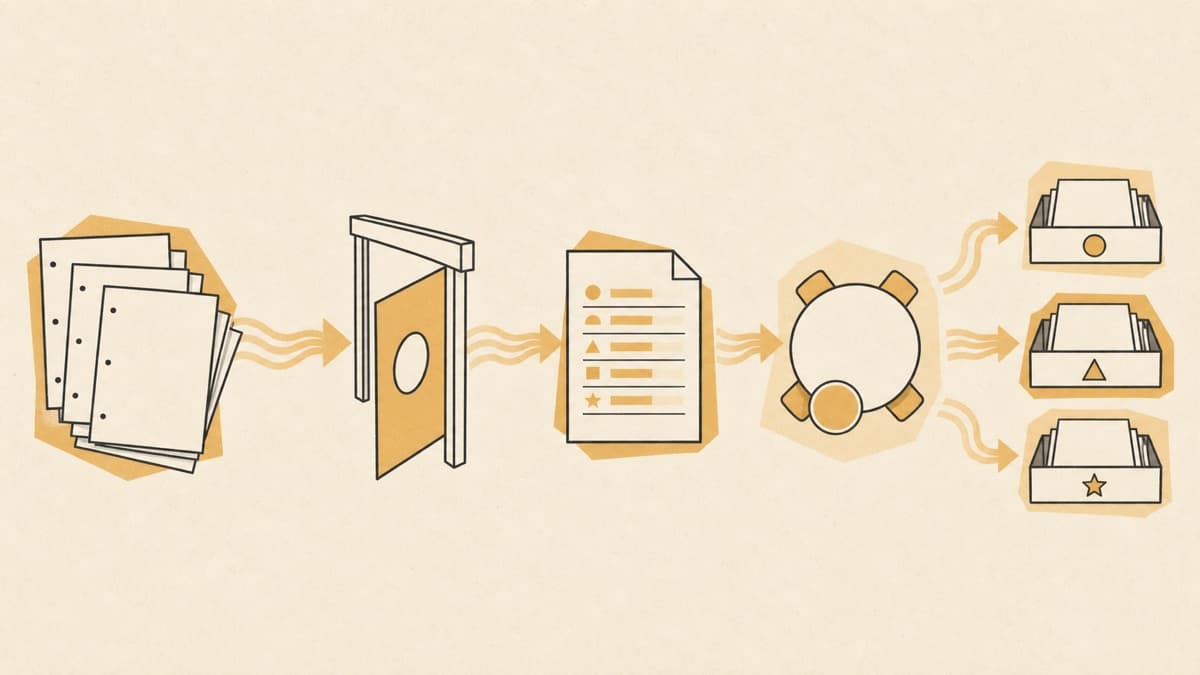
A development team does not evaluate submissions in one step. It receives material, verifies that it can be reviewed, prepares a first read, applies human judgment, and records what happens next.
When those stages blur together, a fast summary can become an unexamined rejection. A sound process makes each decision visible and gives the team a way to audit both readers and tools.
1. Intake
Capture the minimum information needed to identify and route the material:
- Script and title.
- Writer and representative when applicable.
- Format and genre.
- Submission source.
- Date received.
- Draft or source version.
- Requested reader or team.
- Release or eligibility status required by company policy.
Do not begin creative evaluation before required intake and legal checks are complete. The process should distinguish "not eligible to read" from "read and declined."
2. Classification and routing
Confirm whether the material is a feature, pilot, episode, short, or other form. Route it to a reader who understands the format and the company's current needs.
Classification should help, not trap the material. A mislabeled teleplay should be correctable without restarting the whole intake process.
3. First read
The first read creates a common view of the script. A coverage report can include:
- Logline and full synopsis.
- Execution notes.
- Scorecard or rubric.
- Evidence from specific scenes.
- Pass, Consider, or Recommend verdict.
- Questions for a second read.
At volume, AI coverage can prepare this structure quickly. A team still needs rules for when a person reads the screenplay and who owns the disposition.
4. Triage
Triage determines what deserves attention next. It should be based on more than one score.
Useful signals include:
- Clear fit with the company's mandate.
- Strength or distinctiveness of the writing.
- A premise worth discussing despite execution issues.
- A writer relationship or referral that requires a person to respond.
- Reader uncertainty or disagreement.
- Material that could be harmed by the limitations of the first-pass rubric.
Create an exception path. If every script below a threshold is automatically declined, the threshold has become the decision-maker.
5. Human read and discussion
Assign a person before a consequential decision. The reader should inspect the screenplay, not only the report, and be able to explain:
- What the script is trying to do.
- Which execution choices are working.
- What the main development question is.
- Why the material does or does not fit the current need.
- What next action they recommend.
Disagreement is useful data. Record the reasons rather than averaging incompatible opinions into a neutral score.
6. Disposition
Use a small, explicit set of outcomes:
- Decline.
- Hold for another need or reader.
- Request a second read.
- Request a revision or additional material.
- Advance to a meeting.
- Promote into active development.
Record the decision, owner, date, and rationale. Keep the submission and report available according to company policy.
Measure the process
Throughput alone can reward shallow reading. Track a balanced set of measures:
- Time from receipt to first read.
- Time from first read to disposition.
- Percentage receiving a human read.
- Reader disagreement and override rate.
- Reopened or reversed decisions.
- Conversion from submission to meeting or active development.
- Cost per completed stage.
- Writer or representative response time when applicable.
Audit a sample of declines and advances. The purpose is not to prove the process was right. It is to learn where the rubric, reader calibration, or routing logic failed.
Preserve the crossing into development
A submitted script and an actively developed title serve different jobs. Keep the intake queue focused on evaluation. When a project advances, promote it into the Library with its source version, Coverage, and provenance intact.
The best submission system does not make more decisions. It makes the team's real decisions faster to prepare, easier to inspect, and harder to lose.
A team defining the first-read stage can use what script coverage includes, then calibrate readers with the coverage-writing framework and template.
Add a structured first read to your queue
Prescene Coverage keeps submitted scripts and their reports together, with a clear path into the Library when a title moves forward.