

What is script coverage?
Script coverage turns a screenplay into a concise synopsis, evaluation, and scorecard so a development team can decide what to read or discuss next.
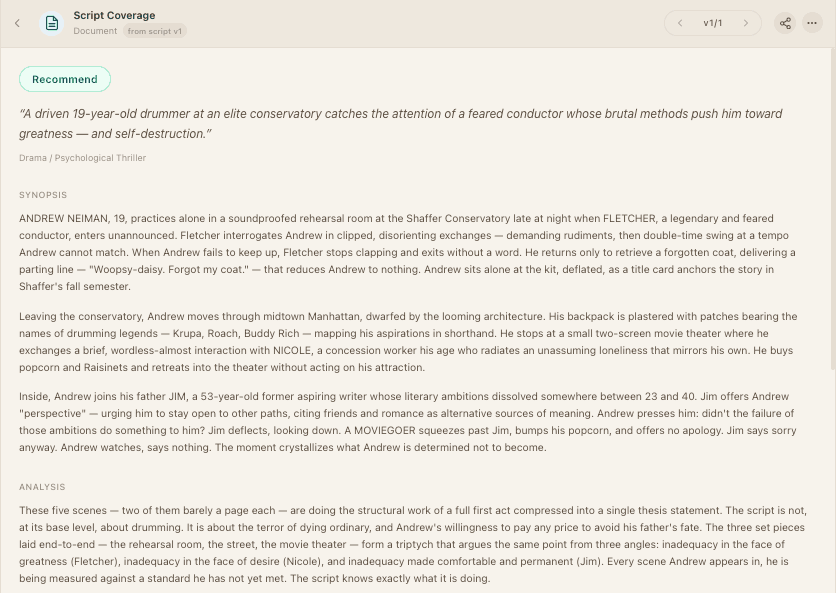
Script coverage is a structured first read of a screenplay. It condenses the material into a synopsis and an evaluation so a writer, producer, representative, or development executive can understand the script before deciding what to do next.
Coverage is not a substitute for reading the screenplay when a decision matters. It is a decision aid. Good coverage tells you what the script is, how it is working, where the reader found evidence, and which questions deserve a closer read.
What is included in a coverage report?
Formats vary by company and purpose, but a practical report usually contains five parts.
1. Identifying information
The title, writer, format, genre, draft, page count, and reader help a team keep the report attached to the correct source version. This matters when several drafts of the same project are circulating.
2. Logline and synopsis
The logline compresses the dramatic premise into a few sentences. The synopsis explains the full story, including the ending. A synopsis is not promotional copy. It should make the plot legible to someone who has not read the screenplay.
3. Evaluation
The evaluation discusses the script's execution. Common areas include premise, plot, character, dialogue, structure, pace, tone, theme, and craft. The useful question is not whether a category received a number. It is why the reader reached that assessment and what in the script supports it.
4. Scorecard or rubric
A rubric gives multiple readers a shared vocabulary. It can make a submission queue easier to compare, but the score should never float free from the written rationale. A seven for character means little unless the report explains which character choices, relationships, or turns produced that judgment.
5. Verdict and next action
Many companies use Pass, Consider, and Recommend. Others use custom decisions or no verdict at all. The label is less important than the action it supports: decline, request another draft, assign a second reader, discuss in a meeting, or move the project forward.
Who uses script coverage?
Coverage serves different jobs for different readers.
- Development teams use it to triage incoming material and prepare discussions.
- Producers use it to understand a project before considering development, packaging, or financing work.
- Representatives use it to prepare for client conversations and assess new material.
- Writers use it as one source of structured feedback before a rewrite.
- Educators and programs use a common rubric to give a cohort more consistent feedback.
The intended reader should shape the report. Internal studio coverage may emphasize fit and execution. Writer-facing notes may spend more time on revision choices. A one-size report can miss the actual decision.
Coverage is not the decision
A screenplay can succeed for reasons that resist a scorecard. Voice, taste, timing, relationships, casting, budget, and a buyer's current needs all affect what happens next. Two experienced readers can interpret the same choice differently.
That does not make coverage useless. It means the report should expose reasoning rather than conceal it behind a grade. A development team can disagree with a report and still use it to find the right scene, test an assumption, or prepare a better conversation.
Human and AI coverage
Human readers bring taste, lived experience, relationships, and an understanding of the buyer's context. AI coverage can provide a fast, repeatable first pass across a larger volume of material. The best workflow depends on the decision and the cost of being wrong.
For a high-volume submission queue, a team might use AI coverage to prepare summaries and surface questions, then assign people to the material that warrants judgment. A writer might use an AI report before sending a draft to a trusted reader. A greenlight or representation decision should still involve people who own the outcome.
How Prescene approaches coverage
Prescene returns one standard report with a logline, synopsis, ten category scores, and written rationale grounded in specific scenes. Complete-script reports show an Overall Score and a score-derived Pass, Consider, or Recommend verdict. Eligible feature, television-pilot, and television-series reports can also include a frozen, versioned format ranking. Calibrated reference rankings are labeled separately from hybrid or live aggregate rankings, and each report records the data cutoff and publication date it used. Work-in-progress reports show the same ten categories as provisional, label the aggregate Current Trajectory, and omit the verdict and ranking. Every report stays connected to the script and its source version, so it can become the start of a discussion rather than a detached score.
AI script coverage starts at $49/mo with Plus and is also included with Pro and Max. Processing time varies by script length and demand, and progress remains visible while the report runs.
A practical quality check
Before relying on any coverage report, ask:
- Did the reader evaluate the complete screenplay?
- Is the synopsis accurate, including the ending?
- Does each major judgment point to evidence in the script?
- Is the rubric appropriate for the reader and decision?
- Can another person understand why the major conclusions were reached?
- Is the report attached to the correct draft?
- Does it identify uncertainty instead of hiding it?
Coverage earns trust by making the screenplay easier to inspect. The report should help a team read more deliberately, not give it permission to stop reading.
Continue with the coverage-writing guide for evidence-led notes, or use the AI coverage-tool evaluation framework when comparing software and version workflows.
See coverage on your own script
Upload one screenplay and receive a structured report with a synopsis, scores, and scene-specific rationale.