

A screenplay is structured story data
Scene headings, character cues, dialogue, action, and draft history create a structured source that can support search, comparison, coverage, and downstream workflows.
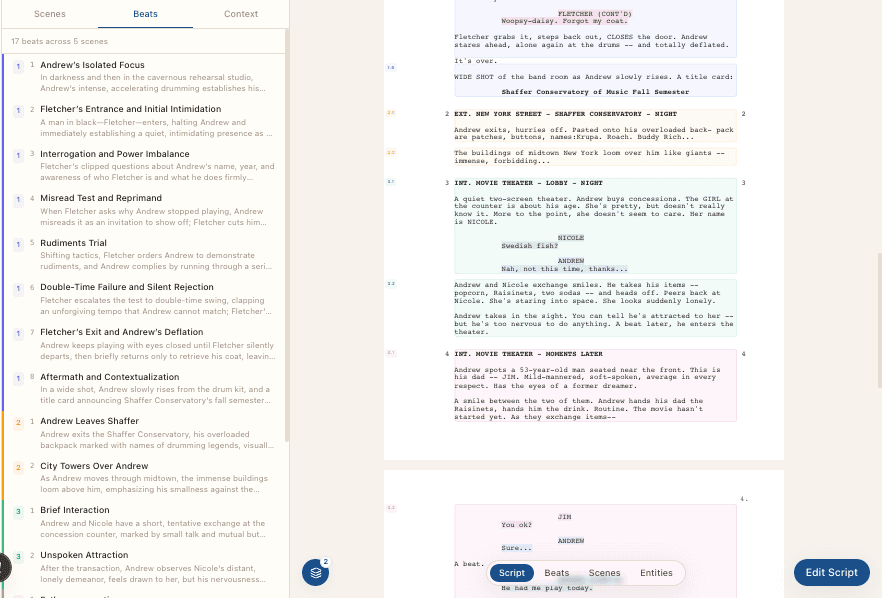
A screenplay is a document, but it is not unstructured prose. Scene headings identify place and time. Character cues identify speakers. Dialogue and action follow a repeatable grammar. Draft labels and revisions add another layer of meaning.
When a system preserves that structure, the screenplay can support more than full-text search. Scenes, characters, relationships, locations, source spans, and versions become addressable parts of the same story.
The structure already on the page
Screenplay format carries useful signals:
- A scene heading usually identifies interior or exterior, location, and time of day.
- A character cue marks who speaks.
- Parentheticals qualify a performance or delivery.
- Dialogue belongs to a speaker and a scene.
- Action describes visible events, entrances, exits, props, and changes in state.
- Transitions and sequence labels can signal editorial or structural intent.
Parsing these elements is the first step. It is not the same as understanding the story.
The line INT. MARA'S APARTMENT - NIGHT can become a location and time record. Understanding that Mara returns there after a betrayal, hides evidence, and lies to her sister requires context across the scene and the larger script.
From parsed text to story intelligence
Story intelligence connects the screenplay's format to narrative meaning.
Scenes become evidence units
A scene can retain its heading, page range, participants, summary, actions, and relationship to surrounding scenes. A user can ask where a claim came from and return to the source.
Characters become continuous identities
Names on the page may vary. A character can be introduced formally, referred to by a nickname, or renamed between drafts. A useful system connects those mentions without erasing the original text.
Relationships become traceable
It is one thing to list that two characters share scenes. It is more useful to track how their goals, conflict, trust, and knowledge change across those scenes.
Versions become part of the answer
"What happens in the script?" is incomplete when a project has six drafts. The answer should identify the source version and distinguish current analysis from an older report.
Collections can roll up
A series is not a folder of unrelated episode PDFs. Characters, locations, themes, and unresolved story information continue across episodes and seasons. Structured episode intelligence can support a living series-level view while retaining evidence in each script.
Why generic document chat falls short
A general retrieval system can find passages that resemble a question. That is useful, but it may not preserve story identity, draft lineage, hierarchy, or source-grounded relationships.
Consider four questions:
- Which version of the pilot introduced the sister?
- How did her relationship with Mara change across season one?
- Which scenes support that conclusion?
- Which current artifacts were produced from an older draft?
Answering them reliably requires more than chunks of text. The system needs canonical entities, source versions, story hierarchy, and provenance.
What structured story intelligence enables
Once the source is organized, the same underlying knowledge can support several jobs:
- Search for a line, scene, location, or character moment.
- Ask questions about the complete script.
- Generate Coverage and other artifacts from a known source version.
- Compare drafts and identify meaningful changes.
- Build character and series-level views across episodes.
- Let an external assistant query the Library through MCP or an API.
- Keep a report connected to the exact material that produced it.
These are not separate readings of the screenplay. They are different uses of one maintained intelligence layer.
What the model should not do
Structure does not make interpretation certain. A character's motive can remain ambiguous. A scene can support multiple readings. A theme may be deliberate, accidental, or still emerging in the draft.
A trustworthy system should show evidence, identify the version, and leave room for disagreement. Story intelligence is most valuable when it makes judgment easier to inspect.
The practical shift
Treating a screenplay as structured story data changes the downstream workflow. A team does not need to rebuild context from the PDF for every report, comparison, question, and tool. It can read once, preserve the source, and reuse the resulting knowledge while the project evolves.
The screenplay remains the authority. The intelligence layer makes that authority available wherever the work happens.
The practical applications begin with screenplay analysis and become especially visible when a team needs to compare two drafts without rebuilding its understanding from scratch.
Build working knowledge of a script
Start a screenplay draft in the free Editor. Subscribe to add it to your Library and build working knowledge of every scene, character, and source version.