

Story intelligence for TV series and episodic development
Series development needs continuity across episodes, seasons, characters, and source versions without losing the underlying script evidence.
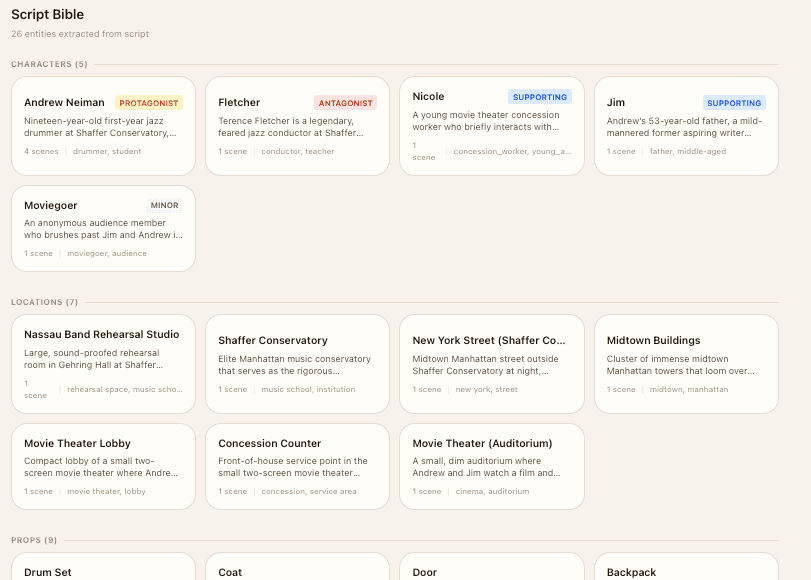
A feature screenplay can often be evaluated as one document. A television series cannot. The useful unit changes as the work moves from pilot to season and from season to continuing series.
Series development needs episode-level evidence and title-level understanding at the same time. Flattening every teleplay into a list loses continuity. Collapsing everything into one summary loses the source.
The hierarchy matters
A practical model keeps the creative hierarchy visible:
Series
└── Season
    ├── Episode 1
    │   └── Source versions
    ├── Episode 2
    │   └── Source versions
    └── Episode 3
        └── Source versions
Each episode has its own script, scenes, characters, and draft history. The season and series need rollups that are built from those episodes rather than copied into a separate, disconnected document.
Four continuity problems a series must solve
Character identity
A recurring character may be named differently across scripts. A pilot can introduce "DR. ELENA VARGAS" while later episodes use "ELENA." A series view should connect those appearances without changing the source text.
Knowledge and relationship state
Who knows the secret by episode six? When did two characters stop trusting each other? Which episode changed the power balance? These questions require evidence across several scripts.
Story movement
An episode can close its local plot while advancing a seasonal arc. The system should distinguish episode resolution from unresolved series movement.
Draft lineage
A later draft can change the setup for an episode that has already influenced a bible or Coverage report. The team needs to know which source version produced each conclusion.
What belongs in a living series bible
A useful bible is more than a pitch document frozen at the start of development. It can maintain current working knowledge of:
- Series premise, world, tone, and format.
- Season and episode summaries.
- Canonical characters and aliases.
- Character wants, relationships, and arc movement.
- Important locations, organizations, and story entities.
- Established facts and unresolved questions.
- Source episodes and versions supporting each conclusion.
This does not replace the writer's room bible or creative plan. It gives the team a current evidence layer over the scripts that actually exist.
Coverage changes at series level
Per-episode scores can create a misleading picture of a television title. A pilot, bottle episode, finale, and bridge episode do different jobs. Treating them as independent films ignores the season design.
Series Coverage should evaluate the title as a living whole. New episodes become additional evidence. When the series changes, the report can update while preserving earlier report versions for comparison.
That creates better questions:
- Is the central engine still producing distinct episodes?
- Are character arcs moving across the season?
- Which promises from the pilot have been paid off?
- Where is continuity becoming hard to follow?
- Does the latest episode change the series assessment?
A practical episodic workflow
- Create one series title.
- Add the season and episode position, such as S01E01.
- Upload each teleplay to its episode.
- Add later drafts as source versions of the same episode.
- Review episode-level scenes and character evidence.
- Use the series bible to inspect cross-episode continuity.
- Run or update series-level Coverage when the title changes materially.
- Keep every artifact connected to its source inputs.
The result
Series intelligence should let a team move in both directions. Start from the title and find the episode that supports a conclusion. Start from a scene and understand what it changes for the season.
That is the difference between storing many scripts and maintaining working knowledge of a series.
Start with an episode-level character breakdown, then use draft comparison when a revised episode changes season continuity or a series-level conclusion.
Keep a series understood as it grows
Add episodes to one series in Prescene and build a living view of characters, story movement, and series-level Coverage.